
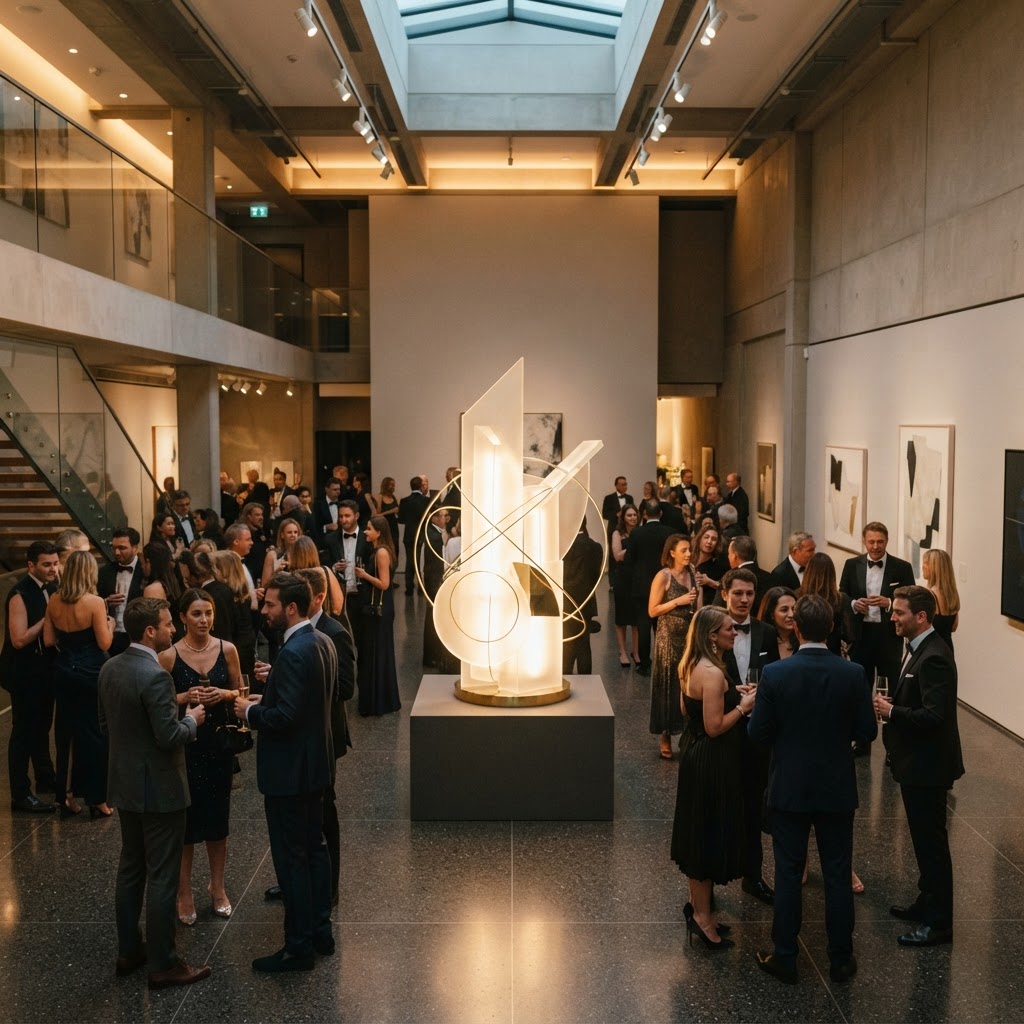
London has always been a city of shifting artistic tides, yet as we settle into the autumn of 2026, the gravitational pull of the capital has decisively shifted toward the refined streets of Chelsea. Far from the industrial grit of the East End, the modern Chelsea arts scene has evolved into a sanctuary of hyper-curated experiences, where the lines between fine art, immersive technology, and exclusive social theater blur into something altogether more profound.
The New Vanguard of Kings Road
Stepping into the newly unveiled Galerie de l'Horizon, one is immediately struck by the silence—a deliberate, reverent atmosphere that has become the hallmark of the district’s most exclusive spaces. Curator Elena Vane, who spent a decade at the helm of the Tate’s private acquisitions, has curated a program that moves beyond the traditional canvas. Her current installation features bioluminescent sculptures that react to the heart rates of the room’s occupants, a move she describes as 'the democratization of intimacy through high-concept engineering.'
It is here, amidst the scent of freshly pressed linen and dry martinis, that the new guard of London’s elite gather. The gallery openings are no longer mere cocktail hours; they are tightly choreographed soirées where a single piece can be acquired for seven figures before the second chorus of a private cello performance concludes.
The future of art is not in the object itself, but in the memory of the atmosphere it creates. In Chelsea, we are trading in experiences that simply cannot be archived. — Elena Vane
From Private Salons to Immersive Opera
While the galleries provide the visual bedrock, the soul of Chelsea’s cultural scene in 2026 resides in the private concert halls and hidden ateliers. The Cadogan Conservatory has transformed its Victorian glasshouse into a site for immersive opera, where the audience is not sequestered in stalls but woven into the choreography of the performance. Last week’s premiere of a reimagined 'Tristan und Isolde' saw guests donned in bespoke evening wear, moving through the foliage as the music swelled from hidden, state-of-the-art acoustic chambers.
This appetite for the avant-garde extends to the silver screen as well. The Kensington Cine-Club, an ultra-private membership venue, has become the preferred destination for directors to host private premieres. With only forty seats upholstered in reclaimed vintage velvet, it offers the intimacy of a 1920s parlor with the projection capabilities of a Hollywood studio. It is whispered that the latest A-list film, a sweeping period drama shot entirely in the surrounding Chelsea streets, was screened here last month for an audience consisting solely of royalty and top-tier gallerists.
The Curated Life
What defines the Chelsea experience this year is the absence of noise. There is a quiet confidence in the way this neighborhood embraces the avant-garde. Whether it is the restoration of the Chelsea Arts Tower to house rotating private collections of contemporary glasswork, or the impromptu jazz evenings held in the basements of townhouses that once belonged to the bohemian giants of the last century, the lifestyle remains grounded in an uncompromising standard of excellence.
For the discerning collector, the season ahead promises even more. The upcoming 'Lumière d'Or' festival is expected to see several private collectors open their doors for the first time, offering guided tours of world-class collections that have never before been seen by the public. It is a period of unprecedented access, provided one carries the right invitation.
As we look toward the winter, it is clear that Chelsea is no longer just a postcode; it is a philosophy. It is an acknowledgment that in a world of digital saturation, the most luxurious commodity remaining is the authentic, tangible, and exquisitely curated moment shared with those who understand its true value.