
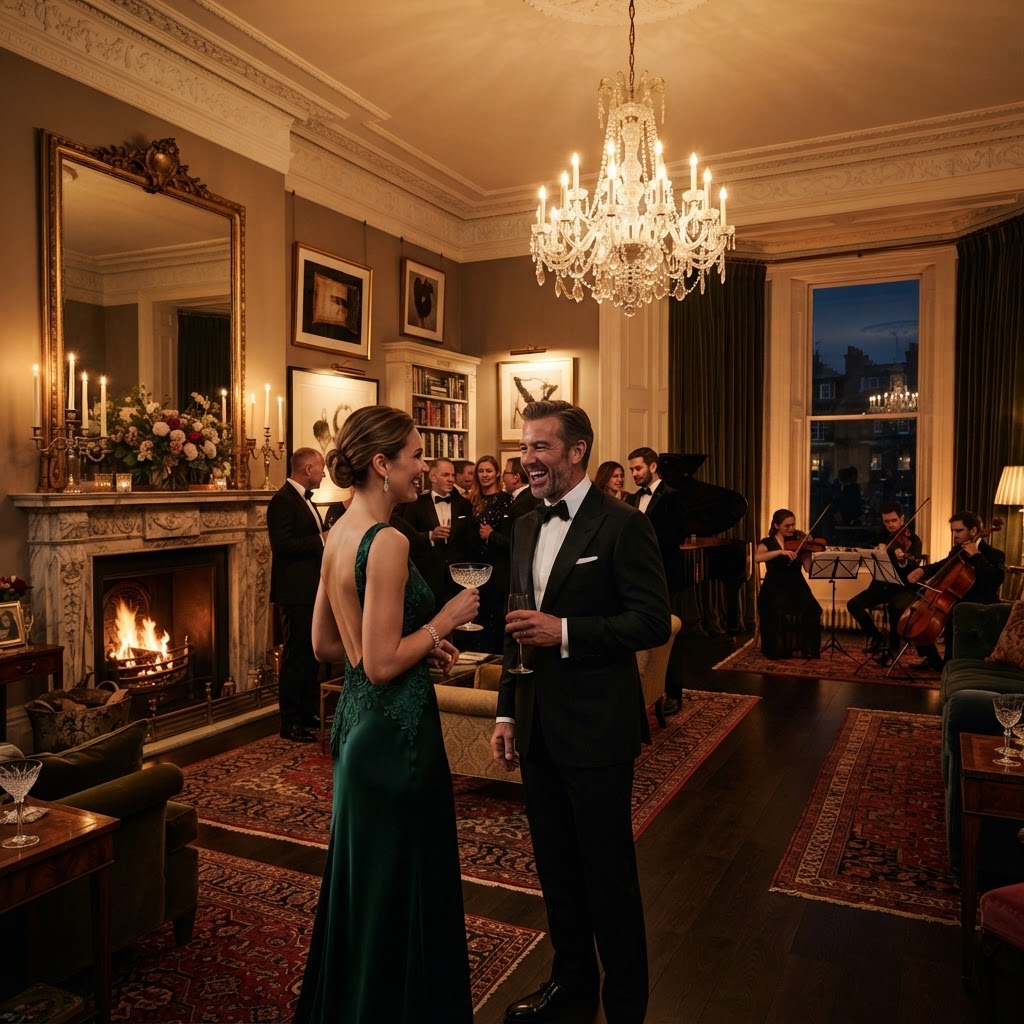
In the quiet, gas-lit corners of Belgravia and behind the formidable mahogany doors of Chelsea’s most storied townhouses, a quiet revolution is underway. The frantic, neon-soaked cadence of the London club scene—a staple of the early century—is rapidly being supplanted by a return to the most decadent of British traditions: the private house party. But this is not the rowdy affair of one’s youth. Today’s host is a curator of experience, and the evening is a performance art piece in its own right.
The New Architecture of Intimacy
As the city’s high-net-worth socialites pivot away from the velvet ropes of Mayfair’s crowded members’ clubs, they are investing in the theatre of home. Design houses such as Soane Britain and firms like Rose Uniacke are seeing a surge in requests for spaces designed specifically for ‘flow’—drawing rooms that transition seamlessly into cocktail parlours, and dining areas that feel less like refectories and more like private galleries.
The house party has become the ultimate status symbol. It is no longer about who gets in; it is about who receives an invitation to the inner sanctum. — Julian Vane, Luxury Hospitality Consultant.
The contemporary host treats their home as a stage. It is common now to see private concerts held in residential ballrooms, with acoustics perfected by engineers who previously worked on the Royal Opera House. A recent evening in a grade-II listed Cheyne Walk residence featured a surprise performance by a rising star from the Royal Academy of Music, accompanied by a string quartet, while guests sipped vintage Krug from crystal commissioned by Saint-Louis.
The Curated Guest List: An Art Form
The modern host understands that the chemistry of a room is as important as the vintage of the champagne. "We are seeing a move away from the 'everyone who is anyone' approach," explains Elena Rossi, a high-end social strategist. "The guest list is now a delicate curation. You might sit between a Turner Prize-winning sculptor, a tech visionary, and an opera director. The goal is friction—intellectual friction that yields conversation, not just networking."
This exclusivity is bolstered by the absence of digital documentation. In these circles, the 'no-phone policy' is not merely requested; it is culturally enforced. This return to analog interaction elevates the event from a photo opportunity to a lived memory, re-establishing the home as the sanctuary of the true elite.
Gastronomy as Theatre
The catering has likewise undergone a transformation. The era of the buffet is dead; the era of the bespoke tasting menu is the new gold standard. It is now de rigueur to hire private chefs who hold Michelin stars to work exclusively in one’s kitchen for the evening. Wines are sourced not from standard merchants, but via private auctions or direct relationships with estates in the Côte de Nuits. Pairings are calculated with the precision of a laboratory experiment, with sommelier services acting as an essential anchor to the night’s proceedings.
As we move into the winter season, these gatherings are becoming the backbone of the London cultural calendar, often serving as the intimate after-parties for gallery openings or ballet premieres. To be invited is to be part of an invisible, opulent network that keeps the city’s cultural pulse beating, far from the prying lenses of the press.
Ultimately, the return of the grand house party is a reclamation of privacy and a celebration of connection. In a world that is increasingly transparent, the most luxurious thing one can possess is the intimacy of a room filled with people who truly belong there.