
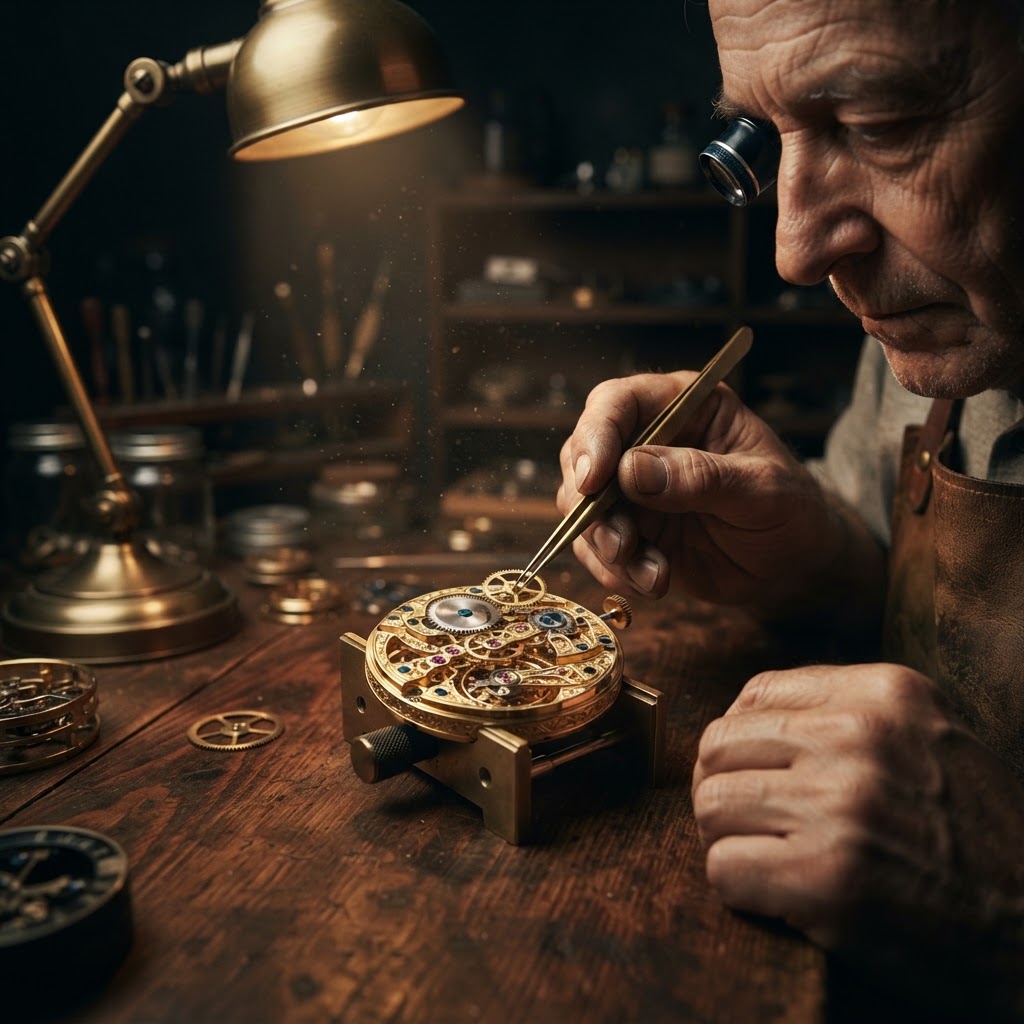
For the discerning collector, the acquisition of a timepiece has long transcended the simple necessity of tracking hours and minutes. In the hushed corridors of London’s most exclusive private members’ clubs—from the leather-clad sanctuaries of Annabel’s to the intellectual retreats of 5 Hertford Street—the conversation has shifted. It is no longer about the rarity of the reference number or the volume of the waitlist. It is about the profound, immutable intimacy of the bespoke commission.
The Anatomy of Personal Narrative
True luxury, in its most elevated state, is a collaborative act. As global supply chains standardise even the most opulent products, the HNW individual increasingly seeks the ‘singular’. To sit across from a master watchmaker in the Vallée de Joux is to participate in an ancient ritual of creation. Whether it is a unique complication requested from Vacheron Constantin’s ‘Les Cabinotiers’ division or an entirely bespoke movement from an independent atelier like Philippe Dufour, the collector becomes the patron of an art form that will outlive them.
The watch is not merely an instrument of precision; it is the physical manifestation of a life well-lived, a mechanical repository for one's own history.
The Craft of Bespoke Curation
We are witnessing a renaissance of the artisanal. Consider the collector who pairs their vintage Patek Philippe with a bespoke strap sourced from the finest heritage tanneries of Italy, or those who commission custom enamel dials featuring motifs hand-painted by artists in Geneva. This level of detail mirrors the precision required in the world of high-end gastronomy and art collecting. Just as one might curate a private cellar of rare Bordeaux or hunt for the season’s first white truffles from Alba, the bespoke watch collector hunts for technical mastery that bears no signature other than their own vision.
This pursuit of the unique is a reaction to the democratisation of the luxury market. When the logo becomes ubiquitous, the connoisseur retreats into the nuances of finish, the architecture of the movement, and the exclusivity of the materials. From using meteorite fragments to bespoke metallurgical alloys, the boundaries are being pushed to satisfy a clientele that demands they be the sole owner of a mechanical soul.
The Legacy of the Independent
Independent watchmakers such as F.P. Journe and Rexhep Rexhepi are the vanguard of this movement. They offer more than a timekeeping device; they offer a dialogue. For a generation of collectors, the value is not in the resale potential—though that remains robust—but in the ability to define their own legacy through an object of uncompromising performance. In the quiet solitude of a bespoke commission, the collector finds a sanctuary from the frantic pace of the world outside, a reminder that true value is found in patience, precision, and the courage to demand the extraordinary.