
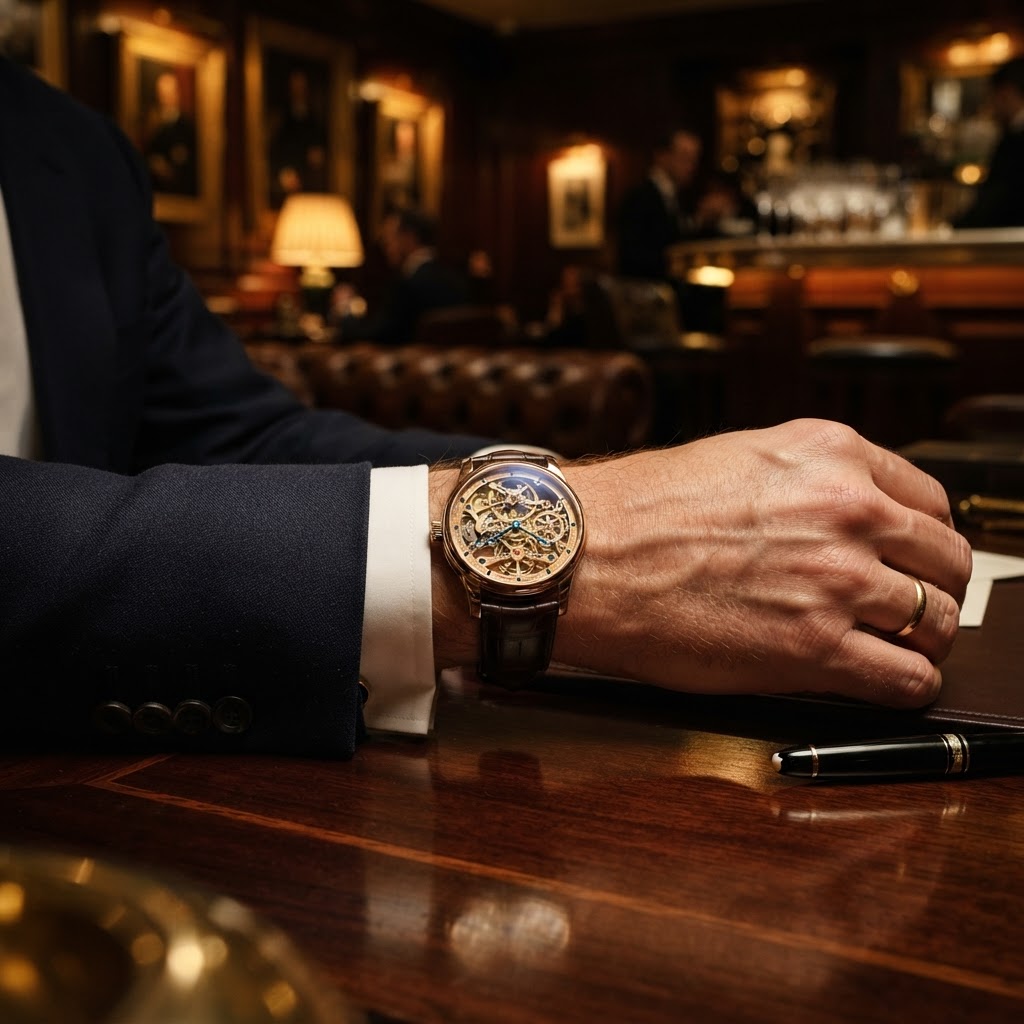
The Anatomy of Distinction
In the quiet, wood-paneled corners of London’s most exclusive private members’ clubs—from the hushed sanctuaries of Annabel’s to the terrace of The Arts Club—a quiet revolution is taking place. While once the measure of a gentleman or woman’s success was codified in the limited-edition serial number on a wrist, the discourse has shifted. Today, true luxury is no longer defined by what one can purchase, but by what one can commission. The art of the bespoke watch has become the ultimate frontier for the ultra-high-net-worth collector, a marriage of mechanical perfection and personal narrative that defies the constraints of retail.
True luxury is the ability to imprint one’s own philosophy onto the gears of history.
At the pinnacle of this movement are maisons such as Patek Philippe and Vacheron Constantin, whose 'Grand Complications' workshops operate not as factories, but as ateliers of heritage. For the dedicated client, the process begins not with a catalogue, but with a dialogue. It involves months of consultation, where the choice of dial texture, the subtle aesthetic of the bridge engraving, and the weight of the platinum case are orchestrated to reflect the owner’s singular vision.
The Provenance of Personalisation
To commission a timepiece is to enter a multi-year conversation with a master watchmaker. Unlike the hurried acquisition of a hyped stainless-steel chronograph, the bespoke process is an exercise in patience—a virtue that itself is a mark of the elite. 'A bespoke watch is not merely an instrument for tracking hours; it is a manifestation of legacy,' notes Julian Thorne, a leading consultant for independent horology. 'When you select a unique movement finish or a dial crafted from stone sourced from a specific, sentimental location, you are embedding your identity into the machine.'
This philosophy mirrors the broader shifts within the luxury sector. Just as a collector of fine wines might source a singular barrel from a boutique vineyard in the Côte de Nuits, or a gastronome might demand a specific provenance for their white Alba truffles, the watch collector now seeks the tactile and the artisanal. The movement toward 'bespoke' is a rejection of the algorithmic uniformity that has permeated much of the modern marketplace.
Beyond the Dial: The Collector’s Ecosystem
The rise of the bespoke timepiece does not exist in a vacuum. It is inextricably linked to the broader curation of a refined life. Consider the synergy: a weekend spent at a remote wellness retreat in the Swiss Alps, punctuated by a bespoke watch fitting; an evening of rare vintage pairings at a private dining table in Mayfair; or the meticulous care given to one’s high-end skincare regimen to ensure the hands—and thus the wrist—remain a fitting frame for a mechanical masterpiece. The bespoke watch is the final, essential accessory to a life lived with intent.
Independent watchmakers, particularly those operating out of the Val-de-Travers, are currently the darlings of the cognoscenti. Names such as Philippe Dufour and Kari Voutilainen represent the apex of this shift. Their work is characterized by hand-finished anglage, black-polished steel components, and a refusal to compromise for the sake of scale. When a collector commissions a piece from these artisans, they are acquiring a fragment of time that has been nurtured, not merely assembled.
The Investment of Authenticity
While the financial appreciation of bespoke horology is often significant, those who engage in these commissions rarely speak of ROI in fiscal terms. Instead, they speak of 'emotional equity.' The value lies in the story behind the piece—the specific hue of a hand-guilloché dial, the personal engraving on the rotor, or the provenance that ensures the watch will never be replicated. It is the ultimate antidote to the volatility of the secondary market; it is a piece that exists outside of time, serving as a permanent anchor to a moment, a desire, or a legacy.
As we look toward the coming year, the appetite for this level of personal expression is set to intensify. The modern collector understands that while art on the wall is admired from afar, art on the wrist is a constant companion—a mechanical heartbeat that echoes one's own sense of style, values, and uncompromising standard of living.