
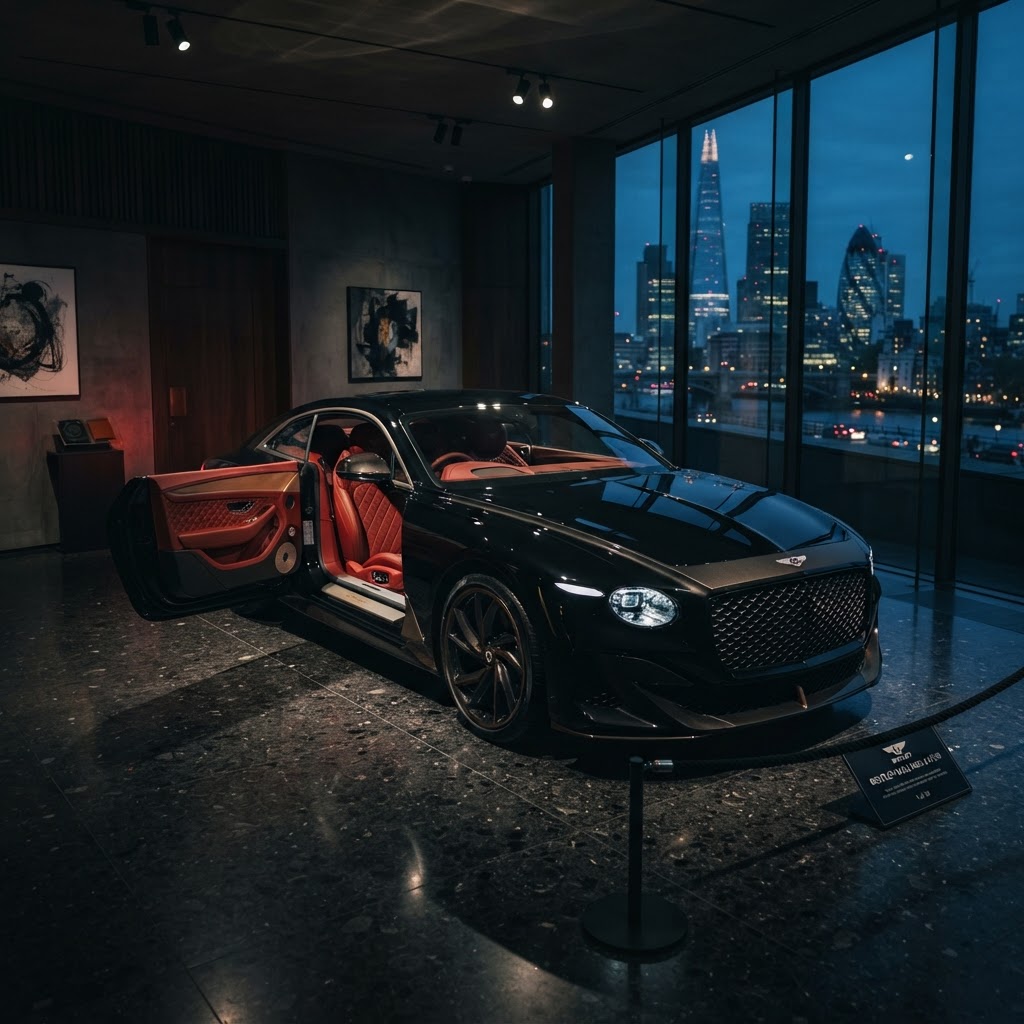
In an era of mass-produced luxury, true exclusivity has become the rarest commodity of all. For the discerning collectors who populate the gilded postcodes of Chelsea and Knightsbridge, the standard showroom specification is no longer sufficient. Enter the renaissance of Mulliner, Bentley’s bespoke division, which is currently transforming the automotive landscape into a theatre of personalised expression.
The Return of the Coachbuilt Grandeur
Historically, the golden age of motoring was defined by the coachbuilder—an artisan who took a mechanical chassis and draped it in bespoke steel and leather to suit the whims of aristocracy. Today, Bentley is reviving this tradition. With projects like the Bacalar and the Batur, Mulliner is not merely selling a car; they are offering a canvas upon which a client’s identity is permanently etched.
The motorcar is no longer a tool of transport; it is a sculptural extension of the collector’s legacy.
From Crewe to the Curated Gallery
Unlike the raw, high-revving aggression of a Ferrari or the track-focused precision of a McLaren, a Mulliner-commissioned Bentley occupies a different psychological space. It is the sophisticated choice for those who view a Porsche 911 GT3 as a weekend toy but require a sanctuary for the daily commute. I recently sat with a lead designer in Crewe, who noted that current commissions often involve materials traditionally reserved for high-end horology—think 3D-printed gold, stone veneers from India, and reclaimed wood aged over five millennia.
The Investment Landscape
For the ultra-high-net-worth individual, the lines between automotive passion and asset class have blurred. While a classic Aston Martin DB5 remains a staple of any serious portfolio, the 'bespoke new' has become the hedge of the modern era. Just as the value of a blue-chip painting is tied to its provenance and rarity, these one-of-one Bentley commissions are already seeing significant appreciation in the private sale markets of Monaco and Geneva.
Beyond the Chassis
The experience of commissioning a Mulliner project is akin to commissioning a portrait. It involves private consultations, fabric swatches flown in from Italy, and deep-dives into the archives of 1920s motorsport. It is a slow, methodical process that forces the hurried executive to reconnect with the art of patience—a luxury in its own right.
As we look toward the future, one wonders if the hyper-car marques like Lamborghini or Koenigsegg will follow suit, abandoning the ‘track-attack’ narrative in favour of this elevated, tailored approach. For now, however, Bentley stands alone at the intersection of heritage, performance, and pure, unadulterated art.