
Colonel Saab Trafalgar Square: Indian Dining with Memory, Theatre and Soul
London has no shortage of ambitious Indian restaurants. What it has rather fewer of are restaurants that understand that luxury is not simply expensive ingredients, heavy interiors and elaborate presentation.
The best dining rooms create a sense of place.
Colonel Saab at Trafalgar Square does exactly that.
Situated on William IV Street, moments from Trafalgar Square and the West End, Colonel Saab is the second London restaurant created by restaurateur Roop Partap Choudhary. The inspiration is deeply personal: his parents, Colonel Manbeer Choudhary of the Indian Army and his wife Binny, travelled extensively across India, accumulating recipes, memories, artwork and objects along the way. Their son has transformed those journeys into a restaurant that operates partly as dining room, partly as family album and partly as a celebration of the extraordinary regional breadth of Indian cuisine.
That personal element matters, because without it Colonel Saab could easily have become another extravagant West End Indian restaurant.
Instead, it feels unusually specific.
First Impressions
The exterior gives relatively little indication of what awaits inside. Enter, however, and the visual language changes completely.
The Trafalgar Square restaurant is arranged around a bar and lounge, an expansive main dining room, mezzanine level and private dining spaces. Above it all hangs one of the restaurant's defining visual features: a canopy of elaborate Firozabad glass chandeliers, casting a soft theatrical glow across the room.
And then there are the objects. This is not the increasingly familiar restaurant trick of buying a collection of vaguely antique-looking pieces from an interior-design supplier and constructing an artificial history around them. Much of the collection relates directly to the Choudhary family's travels.
Paintings, Indian artwork, historic objects, carved pieces and family memorabilia compete for attention. Even the bar has pedigree: previous accounts of the Trafalgar Square restaurant identify its remarkable marble bar as an Asprey piece associated with the Maharaja of Patiala.
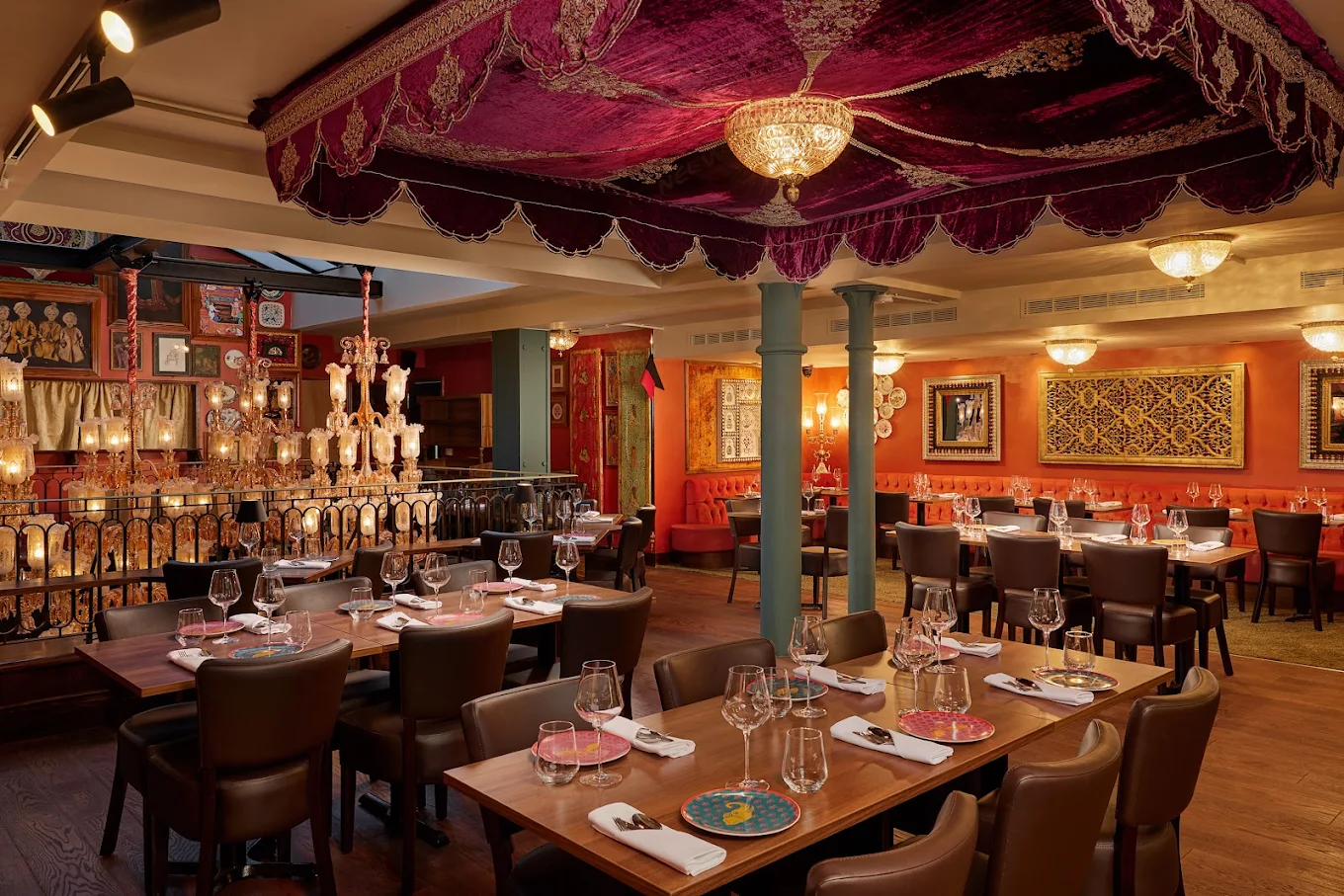
There is a danger with interiors this ornate that the effect becomes theme-park India. Colonel Saab narrowly avoids it.
Why? Because there is warmth underneath the spectacle. Terracotta and earthy tones soften the visual drama. The lighting is low enough to be flattering but not so dark that you need a telephone torch to decipher dinner. The eclectic artwork gives you reasons to keep looking around the room, while old-style jazz and the general murmur of a busy central-London restaurant prevent the space feeling museum-like.
Colonel Saab itself describes the restaurants as having a "contemporary viewpoint with an old soul," which is actually a fair summary of what the room achieves.
It feels grand, but not intimidating. That is harder to achieve than it sounds.
The Food: India Without Reducing India to 'Curry'
Executive Chef Sohan Bhandari leads a menu that deliberately travels rather than settling in one region. His background is in modern Indian cooking, but the interesting thing here is that modernity is generally used as a presentation tool rather than an excuse to erase the original flavours. The restaurant draws on home cooking, street food, royal kitchens and regional dishes from across the subcontinent.
That distinction becomes clear before the main courses arrive.
Chaat & Starters
Mall Road's Dahi Sev Puri
Crisp puri, cooling yoghurt, sweet-and-tangy sauces and texture from sev. Playful food, carefully controlled.
Banarasi Amrood Ki Chaat
Guava meets tamarind chutney, raspberry, spiced cream and crisp gram-flour noodles. Street-food thinking translated into a central-London dining room.
Kandhari Paneer Tikka
Cottage cheese stuffed with prunes and pomegranate, set against tomato, garlic and mustard. Sweetness, acidity and depth.
Tandoori Broccoli
Tender-stem broccoli from the clay oven with creamy dressing and Urfa chilli. A reminder of how naturally vegetables suit Indian spice architecture.
Murgh-e-Malai
Corn-fed chicken breast, marinated and clay-oven cooked, paired with saffron and cardamom.
Kolhapuri Lamb Chops
Spice-rubbed chops with lime-chilli sauce. Unapologetically indulgent — firmly in special-occasion territory.
Spice here does not automatically mean chilli. The kitchen is more interested in layers than endurance tests.
The kitchen is strongest when it remembers that Indian food does not require aggression to announce its presence. Cardamom, mustard, black pepper, coconut, tamarind, fenugreek, saffron, curry leaf and warming roasted spices appear in different combinations. There is heat when a dish requires it, but the cooking is more interested in layers than endurance tests.
Main Courses: Regional Identity Matters
The main-course section is where Colonel Saab's ambition becomes most obvious. A diner who knows Indian food only through tikka masala and korma is being offered several different Indias.
Chicken Chettinad
Tamil NaduAromatic spice profile associated with South India.
Kozhi Thenga Paal Curry
KeralaCoconut milk and spices creating something gentler and more aromatic.
Nadan Meen Curry
South IndiaHome-style fish curry continuing the southern journey.
Beef Pepper Fry
KeralaCoconut and Tellicherry black pepper — bold and warming.
Old Delhi's Famous Lamb Curry
DelhiKeema and pieces of lamb in the style of Delhi meat cooking.
Butter Chicken
House SignatureBoneless chicken in a rich tomato-and-cashew gravy. Deliberately luxurious, immediately recognisable.
Memsaab's Chicken Curry
Family RecipeChicken infused with Indian spices and saffron in a lighter cream sauce with sweet spices. Inspired by the family story behind the restaurant.
A successful butter chicken depends on balance. Colonel Saab wisely doesn't try to deconstruct it into something unrecognisable.
The restaurant's own Butter Chicken uses boneless chicken in a rich tomato-and-cashew gravy. It is immediately recognisable, deliberately luxurious and almost certainly one of the safest choices for a diner approaching Colonel Saab for the first time. But "safe" should not be interpreted as boring. The best versions make you understand why the dish became globally famous in the first place.
The Memsaab Story
One of the most attractive details on the menu is Memsaab's Chicken Curry — explicitly inspired by the family story behind the restaurant, with chicken infused with Indian spices and saffron in a lighter cream sauce with sweet spices.
There is also a broader Memsaab's Tasting Menu, presented as Chef Sohan Bhandari's journey through Indian home cooking and regional flavours — an ode to Indian homemakers. For diners who dislike making decisions, this is arguably the most coherent way to understand the kitchen.
Breads, Rice and the Details That Matter
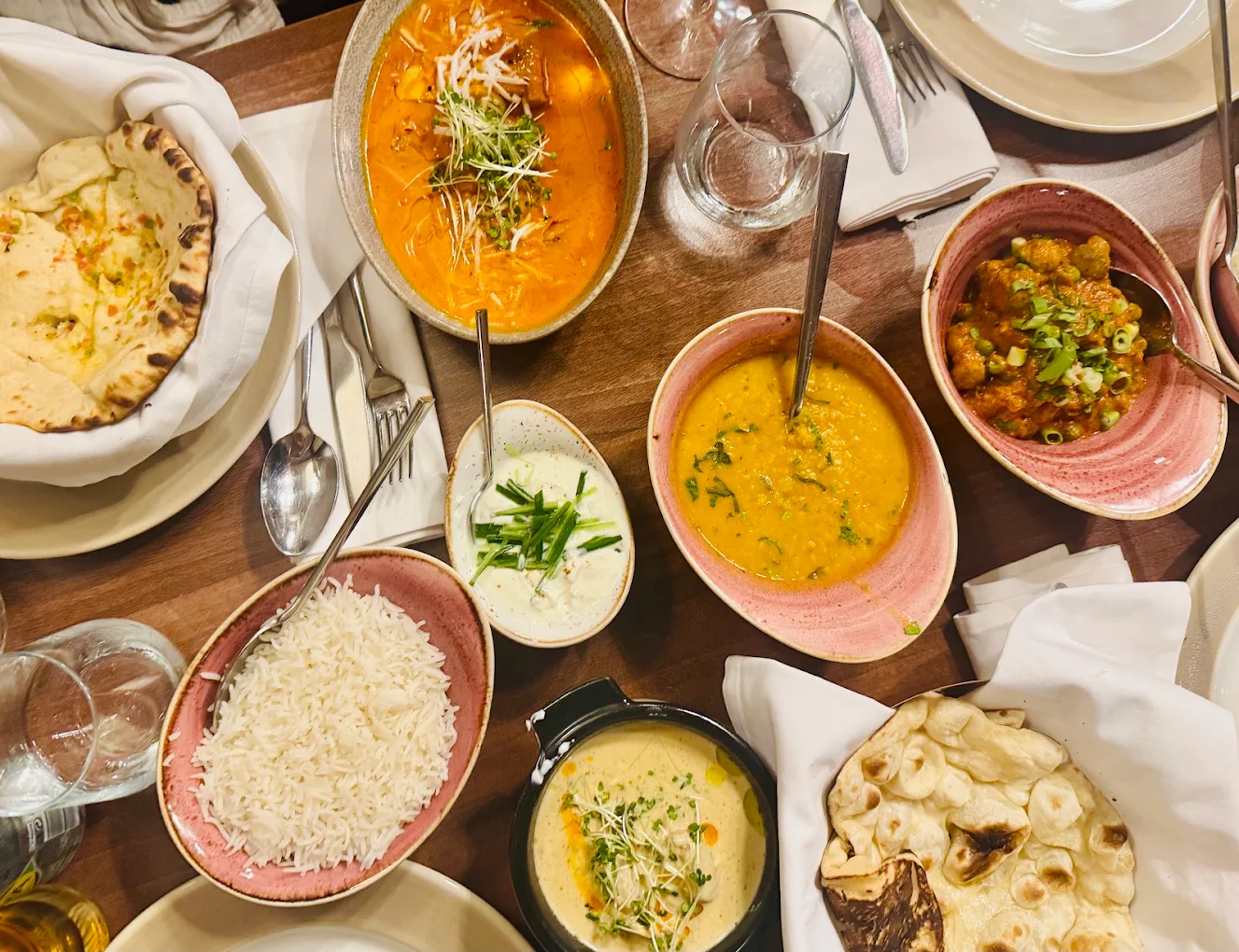
Indian restaurants are often judged by their spectacular dishes when the real test is what happens around them. Bread should arrive hot. Rice should retain definition. Sauces should taste distinct from one another. Accompaniments should provide acidity and contrast rather than act as decoration. That sounds obvious, but it isn't.
Colonel Saab has a broad enough repertoire that restraint becomes important. Order three cream-heavy dishes and the meal can become monotonous no matter how technically competent the kitchen is.
The best way to eat here is to construct contrast: something grilled, something acidic, something vegetable-led, a regional curry, rice, and bread. That is when the menu begins to make sense as a journey rather than a collection of expensive dishes.
Desserts: India Meets the Pastry Kitchen
Dessert is often where ambitious Indian restaurants make one of two mistakes: either abandon Indian flavour completely in favour of generic chocolate fondants, or become overly theatrical. Colonel Saab largely avoids both.
The dessert menu includes recognisable Indian references such as Rose Gulab Jamun and Rasmalai Milk Cake, while other creations play more freely with modern pastry presentation. The important thing is that saffron, rose, milk, cardamom, pistachio and other familiar Indian dessert signatures do not disappear simply because the dining room is in London.
After the depth of the savoury menu, something perfumed and relatively delicate is often a wiser finale than simply choosing the richest option available.
The Bar: Not an Afterthought
Another sign that Colonel Saab considers itself a complete hospitality experience rather than simply a restaurant is the drinks programme. The signature cocktails continue the family narrative.
The Colonel Saab
Paul John Nirvana whisky with chai and coffee liqueur.
The Memsaab
Bourbon with orange, cinnamon and curry leaf.
Kunwar
Indian whisky, Campari, spiced vermouth and rhubarb bitters.
Punchu
Mango vodka, passion fruit, pineapple, lime and orgeat — tropical territory.
It would have been easy for the restaurant to produce gimmicky "Indian-inspired" cocktails by simply putting cardamom into everything. Instead, the better drinks use Indian ingredients as accents.
The current menu also makes the financial territory clear: signature cocktails largely sit around the mid-to-high £15–£20 range, with a discretionary 12.5% service charge added to the bill. Colonel Saab is not pretending to be cheap.
Service: Hospitality Rather Than Choreography
The front of house deserves particular attention because this sort of menu requires staff who actually understand what they are serving. Service at its best here is explanatory without becoming a lecture.
Diners repeatedly mention staff discussing South Indian flavours, explaining unfamiliar dishes and making useful recommendations rather than simply taking orders. Current verified-diner data is notably positive: OpenTable presently scores the Trafalgar Square restaurant 4.6/5 for service, while TheFork's current diner score is 9.1/10 for service.
That matters. A restaurant can employ exquisite ingredients and spend a fortune on chandeliers, but if a server cannot explain the difference between Chettinad chicken and a Kerala coconut curry, part of the proposition collapses. The strongest service here appears to understand that its role is to help guests navigate.
What repeatedly comes through is warmth. The restaurant is formal enough for an anniversary dinner, business meal or celebration, but the staff do not generally behave as though formality requires emotional distance. People forgive a restaurant many things if they feel genuinely looked after.
Value: The One Area Worth Discussing
Colonel Saab is expensive enough that it needs to be judged as an experience, not merely by the quantity of chicken on a plate. Current starters run from around £12 for chaat into the £20s and £30s for premium grilled dishes. Curries generally occupy the £19–£32 range before rice, bread, drinks and service. Tasting menus move considerably higher.
Several diners identify price as the restaurant's principal weakness. OpenTable's current rating tells the same story numerically: food, service and ambience all score around 4.5–4.6, while value sits lower at 4.1. That feels fair.
If you approach Colonel Saab looking for the best-value curry near Charing Cross, you are asking the wrong question. You are paying for the room, for central London, for service, for an extensive bar, for ingredients and presentation — and for a restaurant that has invested heavily in creating an environment rather than simply filling a dining room with tables.
Perhaps the greatest compliment I can give Colonel Saab is that it is difficult to confuse it with anywhere else.
London increasingly suffers from restaurant interiors designed from the same Pinterest board: pale stone, boucle chairs, one olive tree, flattering beige lighting and a strategically distressed wall. Colonel Saab wants absolutely nothing to do with beige anonymity.
Its chandeliers sparkle. Its art demands attention. Its bar glows. Its tables sit amongst objects that have stories. There is colour. There is history. There is a little excess. Thank goodness for that.
Verified diners currently rate the ambience particularly strongly — 9.3/10 on TheFork — and that is probably the restaurant's most immediately understandable strength.
The Verdict
Colonel Saab Trafalgar Square succeeds because the food and room are telling the same story. Remove the chandeliers and artwork and the menu still makes sense. Remove the food and you would still have a remarkable collection. But bring them together with informed service and you get something much more persuasive.
This is not minimalist Indian cooking. It isn't trying to be. It is generous, decorative, aromatic, nostalgic and occasionally extravagant. Some dishes are deliberately familiar; others introduce London diners to regional combinations they may not encounter on a conventional Indian menu.
And while the pricing will prevent Colonel Saab becoming everyone's weekly neighbourhood restaurant, that isn't really its purpose. This is where you come when dinner itself needs to be part of the occasion. A pre-theatre evening. A birthday. A business dinner where the room needs to make an impression. A long lunch. Or simply that increasingly rare London experience of walking through a restaurant door and immediately realising somebody has actually had an idea.
Colonel Saab is a love letter to India, but importantly, it is written in a recognisable voice of its own.
Special occasions, pre-theatre dining, date nights, business dinners and diners wanting to explore regional Indian cooking in an impressive setting.
Chaat to start, one of the tandoor dishes, a regional curry rather than ordering only familiar favourites, and enough time before dinner to actually look around the room.
Chelsea Monthly
Reviews & Dining · The Indian Issue
A love letter to India, written in a recognisable voice of its own.
Colonel Saab Trafalgar Square succeeds because the food and room are telling the same story. It is generous, decorative, aromatic, nostalgic and occasionally extravagant — and while the pricing will prevent it becoming everyone's weekly neighbourhood restaurant, that isn't really its purpose. This is where you come when dinner itself needs to be part of the occasion.
Colonel Saab Trafalgar Square
Trafalgar Square · Central LondonLondon WC2N 4DD